
NURS FPX 4025 Assessment 1 Analyzing a Research Paper
Student Name
Capella University
NURS-FPX4025 Research and Evidence-Based Decision Making
Prof. Name
Date
Analyzing a Research Paper
Figure 1
Keywords: Gout disease, Telemedicine, Likert scale, Patient satisfaction, Telephone-based management program, Serum uric acid.
Reference
Al Harash, A., Laginya, G., & Ayoub, W. T. (2021). Efficacy and outcomes of a novel telephone-based gout disease management program. The Open Rheumatology Journal, 15(1), 51–56.
Date of Publication: 11 August 2021
DOI: https://doi.org/10.2174/1874312902115010051
Research Article Evaluation
| Criterion | Details |
| Type of Study | This study is a research article reporting on a prospective quality improvement project using a telephone-based gout disease management program. |
| Pyramid Level | This study aligns with the lower levels of the evidence pyramid, specifically Level V, because it is a quality improvement (QI) project. QI falls under non-research evidence, which is categorized as program evaluations, case reports, or expert opinion, rather than controlled experimental research. |
| Methodology | The researchers enrolled 158 patients with gout between 2017 and 2019, provided standard rheumatology care, and then followed them through a structured telephone-based management program. Serum uric acid levels were monitored every four weeks until goals were reached, medication adherence was tracked, and patient satisfaction was assessed using a Likert scale. |
| Credibility Factors | The study was conducted by rheumatology providers, included a relatively large sample size of 158 patients, had IRB exemption as a quality improvement project, and collected both clinical outcomes and patient-reported satisfaction, which strengthens credibility. However, the lack of a control group limits generalizability. |
| Relevance to Diagnosis | The study is important because it shows that telephone-based monitoring helps patients with gout achieve the target serum uric acid level of ≤6 mg/dl.Reaching this goal improves disease control, lowers the risk of flares, and reduces complications. It also highlights telemedicine as a cost-effective and patient-centered approach to managing chronic conditions like gout. |
| Workplace Application | The program can be used in clinics through telephone follow-ups that save patients travel costs and clinic fees. It helps providers check uric acid levels, adjust medicines on time, and remind patients to stay on treatment. By catching problems early, it lowers gout flares and reduces expensive hospital or emergency room stays. |
Sentinel U Patient
Figure 2
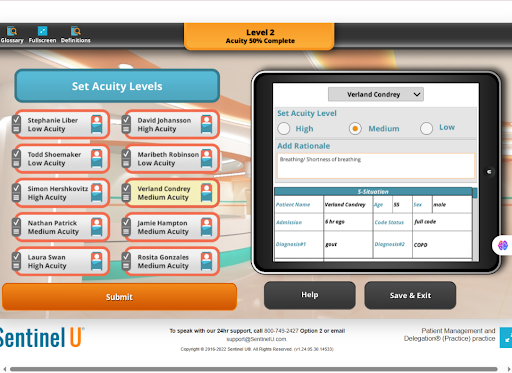
Patient Name: Verland Condrey
Diagnosis: Acute exacerbation of gout with left lower extremity inflammation.
Treatment: Intravenous fluids, intravenous colchicine, and PCA (patient-controlled analgesia) pain medication.
Care: Monitor for shortness of breath, manage pain rated 8/10, provide supportive care, and assess response to medications and fluid therapy.
Summary of Findings
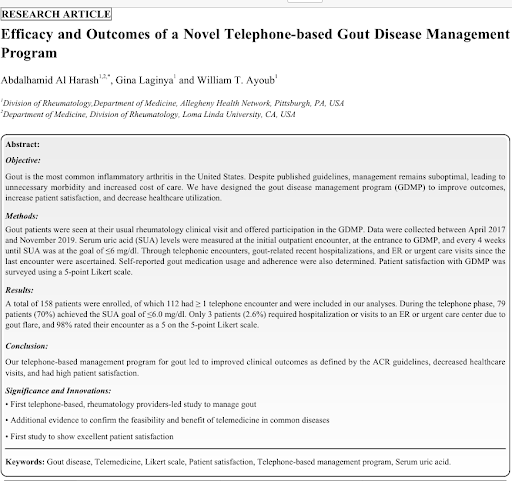
The implementation study and its results were presented in the paper by Al Harash et al. (2021), which addressed the application and its effectiveness of a telephone-based disease management program targeting gout patients. One hundred and fifty-eight patients were enrolled in between 2017 and 2019, and 112 of the enrolled patients were followed up in at least one structured telephone encounter. The major objective of the program was to enhance clinical outcomes through the maintenance of serum uric acid (sUA) as low as possible, at 6mg/dl as advocated by the standard treatment guidelines.
The patients received regular monitoring by phone visits, and during which sessions, the professionals assessed the lab results, revised medication, and encouraged the patients to continue the therapy. Uric acid levels in serum were measured after every four weeks till patients attained their treatment objectives.The outcomes were very successful. By the conclusion of the study, 70 percent of the patients had reached the desired uric acid level. Moreover, compliance of urate-lowering treatment was enhanced and the number of hospitalization and emergency department visits because of gout flares reduced tremendously.
The patient-reported outcomes were also highly favorable since almost all participants reported that they were highly satisfied with the telephonic method. The practicality and patient-centered design of the program enabled patients to receive regular follow-up without having to travel to meet their provider frequently, which is feasible given that the program was practical. Therefore, the results indicate that the structured telephone management may be effective in controlling the disease in gout through promotion of adherence, adjustment of treatment, and prevention of complications. The new model offers the model of care as it is both cost-efficient and innovative enough to supplement the classical management of clinics with a high probability of enhancing patient outcomes and satisfaction.
Relevance and Potential Effectiveness of Evidence
The reason why evidence provided by Al Harash et al. (2021) is applicable to the diagnostics of gout is that the primary aim of treatment is to control the level of uric acid. The research further demonstrates that frequent follow-up enhances medication adherence, flares, and unnecessary hospital visits. Telephone-based care is a very practical method to be used particularly by patients who experience impediments regarding the ability to make regular visits. The program helps in patient-centered care that plays a significant role in nursing practice.
The article is claimed to be credible because it has been published in a peer-reviewed journal in rheumatology and contains more than 100 patients with organized data collection. The findings are understandable and in line with the available guidelines. The primary weakness is that it was not a control group and thus it could not be directly compared with standard care. Nevertheless, the results cannot be disregarded since the program resulted in better clinical outcomes and extremely high levels of patient satisfaction. The results can be applied to practice as they indicate that nurses and providers can rely on telemedicine to promote improved adherence and disease management in gout patients.
NURS FPX 4025 Assessment 1 Analyzing a Research Paper
Article Link
https://doi.org/10.2174/1874312902115010051
References
Al Harash, A., Laginya, G., & Ayoub, W. T. (2021). Efficacy and outcomes of a novel telephone-based gout disease management program. The Open Rheumatology Journal, 15(1), 51–56. https://doi.org/10.2174/1874312902115010051